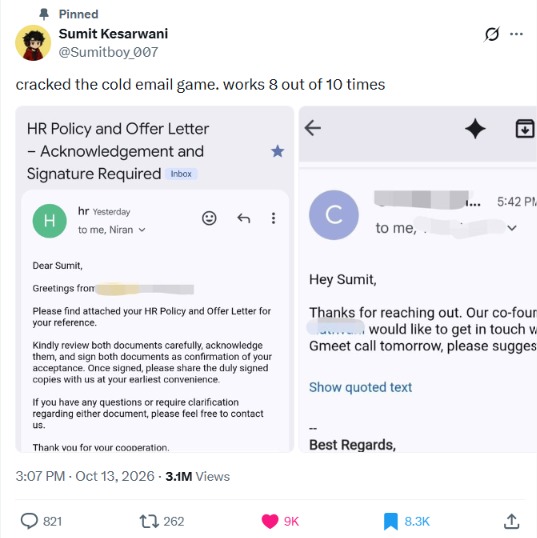

Recently, I shared a post on X about cold outreach that crossed 3.1 million impressions, 9K likes, 262 reposts, and 8.3K bookmarks, and brought in 1,000+ DMs across X, LinkedIn, Gmail, and WhatsApp. Some people even booked calls after checking out my portfolio.
For context, I'm a final year student who started grinding DSA in my first semester and building projects in my second. Since then, I've solved 2,000+ competitive programming problems, completed four paid internships, including an onsite internship at AIT Thailand, and worked with 15+ clients across different countries. I'm currently working at a stealth startup and continuing to explore new opportunities.
After the post went viral, I kept seeing the same questions: What should you write? Who should you contact? How do you get replies?
So, instead of answering everyone individually, here's the playbook.
1. Before Anything Else, Understand Why Most Cold Emails Fail
Most people approach cold outreach like this:
Find 100 email addresses. Copy a template. Change the recipient's name. Attach a resume. Hit send.
Then wait for replies.
And when nobody responds, they conclude that cold emailing doesn't work.
The problem is often the message itself.
Imagine you're a founder receiving this email for the twentieth time that week:
"Hello Sir, I am looking for an internship opportunity at your esteemed organization. Please find my resume attached. Kindly let me know if there are any openings."
What makes this message worth responding to?
It doesn't explain why the sender chose your company, what they can contribute, or why you should spend time looking at their resume.
Now imagine receiving a message from someone who has looked at your product, understands what your team does, and shares a project that's relevant to your work.
That's a different conversation.
The goal of a cold email isn't to ask a stranger for a favour. It's to give them a genuine reason to start a conversation with you.
Let's get practical.
2. Cold Email Templates You Can Actually Use
This is the section most people came here for.
You don't need complicated vocabulary, a three paragraph introduction, or a message that sounds like it was generated by AI.
You need a clear reason for reaching out, relevant proof, and an easy next step.
Here are the templates I'd start with for different situations. Copy the structure, personalize the details, and use the one that matches your goal.
GitHub: [link]
[Your Name]
Why this works: You're not just asking for a job. You're connecting your experience to the company's work and giving the founder something concrete to evaluate.
Make it better: Replace the generic opening with a genuine observation about the company's product. One specific sentence can make the message feel much more personal.
[Your Name]
LinkedIn: [link]
Portfolio: [link]
Why this works: It gets straight to the point. The recipient knows which role you're interested in, what makes you relevant, and where to evaluate your work.
Make it better: Read the job description before sending the email. If the role emphasizes backend development, highlight relevant backend experience instead of listing every technology you know.
[Your Name]
Why this works: You're giving the person enough information to assess your profile instead of asking for a referral without context.
Make it better: Check whether the role is still open, include the job link, and attach your resume if appropriate. Don't make someone search for the information they need to help you.
[Your Name]
Why this works: You're opening a conversation around a potential business problem rather than immediately asking someone to purchase your services.
Make it better: Research the business first. Don't invent website problems or promise revenue increases you can't substantiate. A real observation and a thoughtful suggestion are enough.
Why this works: It's short enough for a quick read while providing context about who you are and why you're reaching out.
Make it better: If you're sending a connection request with a character limit, shorten it further. Start a conversation first, then share your work when appropriate.
[Your Name]
Why this works: It reminds the recipient about your message without demanding a response or repeating your entire pitch.
Make it better: Wait around three to five business days before sending your first follow up. If there's still no response, consider one final polite follow up later. Then move on.
Which Template Should You Use?
Choose the template based on what you're trying to achieve:
| Template | Use Case | Description |
|---|---|---|
| Template 1 | Join a Startup | Reach out directly to founders and explore opportunities to contribute to their teams. |
| Template 2 | Apply for a Role | Contact recruiters or hiring managers about an advertised internship or full time position. |
| Template 3 | Get a Referral | Reach out to employees at your target company and ask for a referral professionally. |
| Template 4 | Find Freelance Clients | Contact business owners with a relevant idea or solution that could help their business. |
| Template 5 | LinkedIn / X DM | Send a short, personalized DM to a founder, recruiter, or professional you'd like to connect with. |
| Template 6 | Follow Up | Send a polite follow up to restart the conversation without sounding pushy. |
One final tip: Don't send the same message to everyone. Choose the template that fits your goal, personalize it with genuine context, and include your most relevant proof of work.
3. The Formula Behind a Good Cold Email
Now that you've seen the templates, here's the structure that connects them.
A. Context: Why are you contacting this person?
Mention something specific about their company, role, product, or recent work.
"I noticed your team recently launched [product/feature]."
This gives the recipient a reason to believe you've chosen them deliberately.
B. Relevance: Why are you a potential fit?
Connect your skills to their work.
"I've been building full stack applications using React and Node.js, with a focus on developing production ready features."
Keep this relevant to the person you're contacting.
C. Proof: What can you show?
Share a project, previous internship, client result, open source contribution, or portfolio.
Don't simply say you're good at something. Show evidence where possible.
D. A small ask: What's the next step?
End with one straightforward question:
- "Are you currently considering candidates for this role?"
- "Would you be open to a quick conversation?"
- "Would it be useful if I shared a few ideas?"
You don't need to ask for a job, a referral, mentorship, and a call in one message.
Use it as a guide, not a rigid script.
4. The Part Most People Ignore: Skills and Proof of Work
You can write an excellent cold email. You can research the founder, personalize every sentence, and choose the perfect subject line.
But what happens when they click your portfolio?
This is where the difference between attention and credibility becomes important.
Cold outreach helps people discover you. Your skills, previous experience, and proof of work help them decide whether you're worth talking to.
Previous experience absolutely matters. An internship, production project, client engagement, or open source contribution can help someone see that you've applied your skills beyond tutorials.
That's part of the reason I've continued building projects alongside competitive programming and pursuing opportunities to work with real clients and teams.
But previous experience isn't the only way to demonstrate your capabilities.
- If you don't have an internship yet, build and deploy a useful project.
- If you don't have clients, solve a real problem and document your approach.
- If your GitHub is empty, start contributing to a project you understand.
- If you have projects but can't explain how they work, spend time understanding your own code.
You don't need four internships or 2,000 solved problems before sending your first cold email. Those are parts of my journey, not prerequisites for everyone.
Start with what you have and make it stronger.
A useful portfolio should quickly answer five questions:
- What did you build?
- What problem does it solve?
- What did you personally contribute?
- Can I see it working?
- What evidence demonstrates the result?
Choose one or two relevant examples rather than sending ten unrelated links.
And never exaggerate your contribution or claim results you cannot support. If someone asks you about your work on a call, be ready to explain it.
Your email earns attention. Your proof builds credibility. Your skills determine what you can deliver.
5. Find the Right Person Before Sending the Email
Even a well written message can fail when it reaches the wrong person.
For a small startup, the founder or co founder might be the right contact. At a larger company, a recruiter or engineering manager might be more appropriate.
For freelance work, look for someone who understands the business problem you can solve.
Before reaching out, ask yourself:
- Why this person?
- Why this company?
- Why am I relevant to them?
Spend a few minutes checking the person's role, company, product, or recent posts.
You don't need to manufacture a personal connection. You just need a genuine reason to start the conversation.
Also, use accurate contact details and respect people's communication preferences. Avoid spamming unrelated recipients or sending repeated messages after someone has asked you to stop.
6. Keep Your Email Short
One common mistake is trying to fit an entire resume into the first email.
Your message doesn't need to include every technology you know, every competition you've entered, every certification you've earned, and every project you've ever built.
Pick what matters to that particular recipient.
- For a backend role, your relevant API, database, or systems experience might be the strongest proof.
- For a frontend role, a polished deployed application might be more useful.
- For a freelance client, relevant work that demonstrates the service you're offering is likely to be more compelling than a list of coding achievements.
A practical target is around 80 to 150 words for many cold emails, although some situations call for less or more.
Use a clear subject line, short paragraphs, and links that work.
Your email should be easy to understand at a glance.
7. What Should You Do When Someone Replies?
Getting a reply is not the finish line. It's the beginning of the conversation.
- If someone asks for your resume, send it promptly.
- If they ask about your experience, answer the question directly and share the most relevant example of your work.
- If they offer a call, suggest a couple of convenient time slots and prepare to explain what you'd like to discuss.
- If they say there isn't an opportunity right now, thank them and leave the relationship on good terms.
- And if they don't reply after your follow ups, move on.
Don't make your entire strategy depend on one person saying yes.
The objective is to create more relevant conversations, not to force a particular conversation to happen.
8. Track What Works Instead of Guessing
If you're serious about cold outreach, keep a simple spreadsheet.
Track the person, company, contact date, reason for reaching out, message version, follow up date, response, and outcome.
Over time, look for patterns.
Are you contacting the right people? Are shorter messages getting more replies? Do relevant portfolio links lead to conversations? Are you targeting roles that match your skills?
Track three useful metrics:
Keep the denominator consistent when comparing results.
Also, don't confuse impressions with replies or replies with job offers. Each measures a different stage of the process.
Test your approach, learn from the results, and adjust.
That's how you improve instead of guessing.
9. The Mindset That Makes the Difference
Here's the principle I'd remember above everything else:
Don't approach cold outreach as asking a stranger to solve your problem. Approach it as finding a reason for two people to talk.
You might be looking for a job. A founder might be building a product. A business owner might need help with a website. An engineering manager might be looking for someone with your skills.
Your job is to identify where there's a genuine connection and communicate it clearly.
You don't need to pretend to be more experienced than you are. You don't need a perfect template. And you don't need to wait until you've achieved everything on your roadmap before you start reaching out.
You need to understand who you're contacting, why your message is relevant, and what evidence you can show to support your claims.
Then keep improving your approach.
Cold outreach isn't a shortcut around learning skills or doing good work. It's a way to help the right people discover that work.
Frequently Asked Questions About Cold Emailing
Answers to the most common questions on reaching founders, landing tech jobs, AI outreach, and writing high-converting cold emails.
How do you write a cold email that gets replies for jobs?
A winning cold email for jobs follows a 4-part formula: Context (specific reason for choosing the company) + Relevance (matching your skills to their current challenges) + Proof (portfolio link or deployed project) + A Small Ask (one simple question like "Are you open to bringing on developers?"). Keep it between 80 to 150 words.
Can you use AI like ChatGPT to write cold emails?
Never send raw AI-generated cold emails. Founders and recruiters read dozens of pitches weekly and spot AI phrasing instantly. While AI can help brainstorm angles, the actual email must contain your personal voice, genuine observations about their product, and real proof of work that no AI can fake.
What is the best cold email subject line for startup founders?
The highest-converting subject lines are direct, humble, and relevant: "Interested in building with [Company]", "[Role] at [Company] | [Specific Skill]", or "An idea for [Product Feature]". Avoid clickbait or robotic sales slogans.
What is the best cold email template for internships?
Use Template 2 from this playbook: identify the role, mention 2 specific technologies you have built with, link your best project, and politely ask if they are still reviewing candidate profiles.
How long should a cold email be?
Aim for 80 to 150 words. Most decision makers read cold emails on their phones during commute or between meetings. If your message requires scrolling, reply rates drop drastically.
How many follow ups should you send for a cold email?
Send 1 polite follow up after 3 to 5 business days. If there is still no response, you may send one final check-in later. If they do not respond, move on respectfully to other targets.
Final Thoughts
The response to my post on X showed me how many people are trying to figure out cold outreach.
I hope this guide gives you a practical starting point.
Choose ten relevant people. Research them properly. Write messages that explain why you're reaching out. Share one useful piece of proof. Follow up respectfully. Track your results.
Then improve.
You don't need to send hundreds of messages every day. You need to get better at starting relevant conversations with people who matter to your goals.
And remember, the "8 out of 10 times" in the title reflects my own experience with this approach, not a guaranteed success rate for everyone. Your results will depend on your targeting, message, proof of work, timing, and what you count as success.
Learn the skill. Build the proof. Send the message.
That's the cold email game.
If this article helped you, share it with someone who's trying to land their first internship, find clients, or get their work noticed. And if you've had success with cold outreach yourself, I'd love to hear what worked for you.